
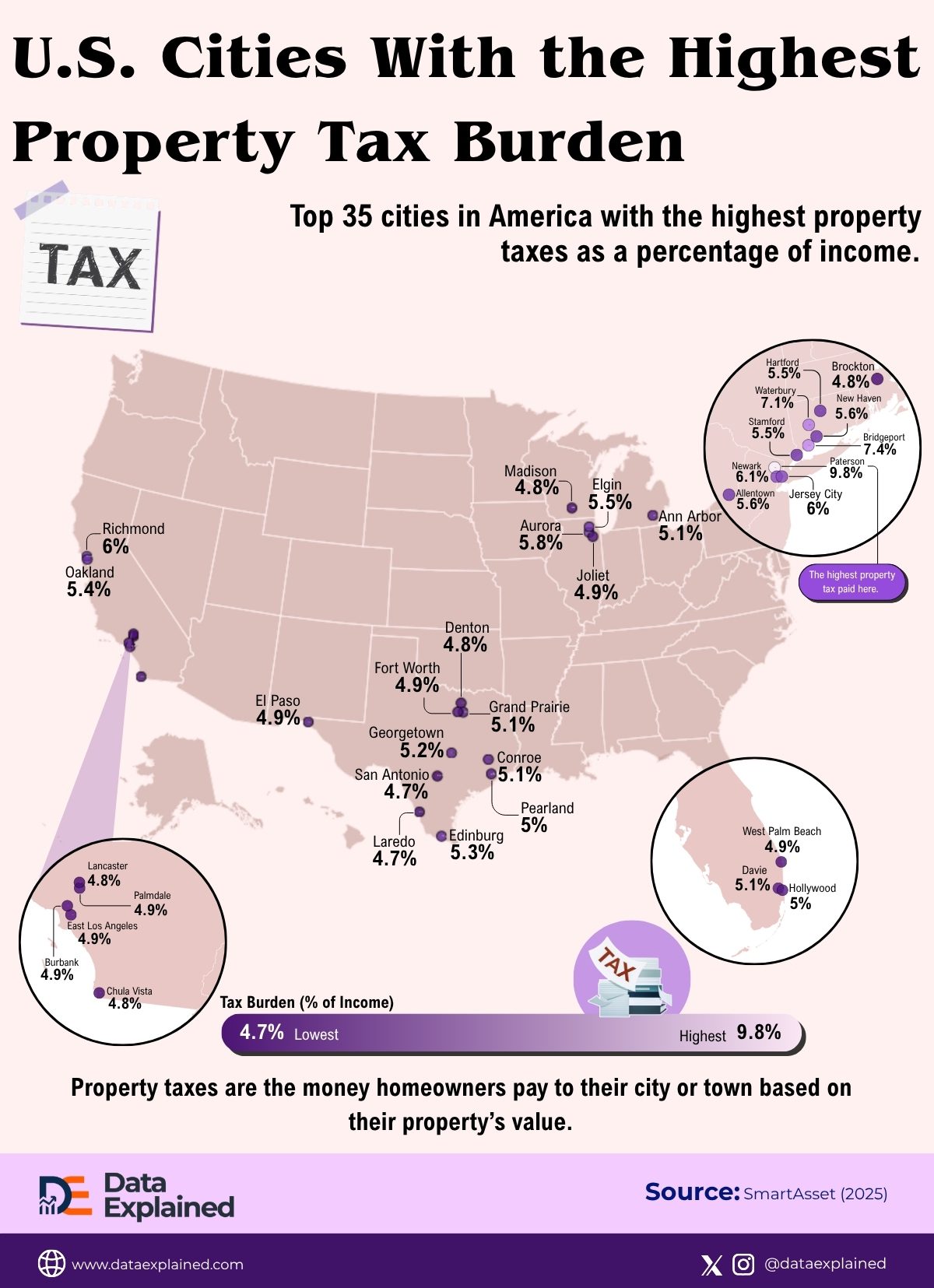
Source: SmartAsset property tax burden data, featured by Data Explained.
Your Paycheck Doubled. Your Texas Property Tax Bill Quadrupled. Here’s the Math.
Your paycheck roughly doubled over the last 25 years. Your Texas property tax bill nearly quadrupled. And every dollar you kept bought less than it did before.
That is not a rounding error. It is a household budget crisis hiding in plain sight.
Since around 2000, Texas median household income has roughly doubled, growing from around $40,000 to around $80,000. On the surface, that sounds like progress. But over that same general period, Texas property tax levies grew nearly 378%, almost four times faster than paychecks.
Inflation makes the picture even harder to ignore. Even when income rises on paper, every dollar does not stretch as far as it used to. Groceries, insurance, utilities, medical bills, home repairs, and everyday expenses all cost more than they did 25 years ago.
So while household income may have increased, the real buying power left after basic expenses has not kept pace. Property taxes are taking up a larger share of what homeowners can actually afford.
For many Texas families, this is not just a tax inconvenience. It is a growing financial squeeze that can push even responsible homeowners behind.
Why Property Taxes Feel Heavier for Texas Homeowners
Texas has no state income tax, and that is a real advantage for many residents and business owners. But the absence of a state income tax does not mean homeowners escape tax pressure.
In Texas, property taxes help fund local services, including school districts, cities, counties, emergency services, and other taxing entities. As property values rise and local budgets expand, tax bills can increase whether or not household income keeps pace.
That is where the squeeze builds. Unlike some expenses that can be reduced or delayed, property taxes come due whether a household has extra room in the budget or not. For homeowners on fixed incomes or families already managing tight monthly expenses, a larger tax bill can quickly become difficult to absorb.
Texas Cities with the Highest Property Tax Burden
A SmartAsset property tax burden analysis, featured in a Data Explained infographic, ranked U.S. cities by property taxes as a percentage of household income. Several Texas cities appeared on the list of the highest property tax burdens in the country.
Texas cities with high property tax burdens as a percentage of gross income include:
Edinburg: 5.3%
Georgetown: 5.2%
Conroe: 5.1%
Grand Prairie: 5.1%
Pearland: 5.0%
Fort Worth: 4.9%
El Paso: 4.9%
Denton: 4.8%
San Antonio: 4.7%
Laredo: 4.7%
Source: SmartAsset property tax burden data, featured by Data Explained.
Put those numbers in context. A homeowner in Georgetown or Edinburg earning $75,000 a year could be sending $3,750 or more toward property taxes before groceries, utilities, insurance, car payments, medical expenses, or anything else.
For many families, that is not a small line item. It can be the difference between staying current and falling behind.
Why Homeowners Fall Behind on Property Taxes in Texas
When someone falls behind on property taxes, the easy assumption is that they were careless or waited too long. In many cases, that assumption misses what is actually happening.
For many Texas homeowners, the problem comes down to three things hitting at once:
- A tax bill that grew faster than income
- Inflation that weakened the real value of every dollar earned
- A household budget with nowhere left to bend
Then one unexpected expense can push the situation over the edge. A medical bill. A job change. A home repair. An insurance increase. Any one of these can create a problem when the budget was already stretched thin.
Falling behind on property taxes is not always a character problem. Often, it is a math problem. And right now, the math is working against many Texas homeowners who are doing everything they can to keep up.
What Happens If You Don’t Pay Property Taxes in Texas?
Unpaid property taxes in Texas do not stay still. Once a balance becomes delinquent, penalties and interest can begin to accumulate. The longer the balance goes unaddressed, the more difficult it can become to catch up.
If the balance remains unpaid, the taxing authority may pursue collection action. Depending on the situation, that can create additional stress and may put the property itself at risk.
That is why acting early matters. The sooner a delinquent property tax balance is addressed, the more options a homeowner may have available.
Options for Help Paying Property Taxes in Texas
Homeowners dealing with delinquent property taxes in Texas are not alone. Across the state, families are facing the same pressure: rising tax bills, higher household costs, and budgets that are already stretched.
The good news is that there may be options available.
Homestead exemptions. Texas homeowners may qualify for school district residence homestead exemptions that reduce the taxable value of a primary residence. Texas now provides a $140,000 school district homestead exemption for most homeowners, and seniors or disabled homeowners may qualify for up to $200,000 when the additional exemption is included. If you have not applied or need to update your exemption status, contact your county appraisal district.
Appraisal protests. Every Texas homeowner has the right to challenge their appraised value each year. A successful protest may help reduce the taxable value of the home and lower the overall tax burden.
County payment plans. Some Texas counties offer installment agreements for delinquent property tax balances. Contacting the tax office before the account escalates further is often worth the call.
Property tax loans. A property tax lender can pay the delinquent balance directly to the county. The homeowner then repays the lender over time through a structured repayment plan. For some homeowners, this can help stop additional penalties, reduce immediate pressure, and create a more manageable path forward.
How Home Tax Solutions Helps Texas Homeowners
At Home Tax Solutions, we work with homeowners across Texas who are navigating exactly this situation. The tax bill grew. The budget did not. Now there is a balance that feels difficult to get ahead of.
We help homeowners review their property tax situation, understand their options, and find a realistic path forward. Whether you are dealing with a first-time delinquency or a balance that has been building for a while, there may be solutions worth exploring.
The earlier that conversation starts, the more options may be available.
Home Tax Solutions works with homeowners throughout Texas, including Georgetown, Fort Worth, Denton, San Antonio, Conroe, Grand Prairie, Edinburg, Pearland, Laredo, El Paso, and surrounding communities.
Get Help with Delinquent Property Taxes in Texas
Texas property taxes are not going to stop being a major household expense. But you do not have to wait until the situation becomes more stressful.
If you are behind on your property taxes or worried about falling behind, Home Tax Solutions can help you understand your options and build a plan that fits your situation.
Contact Home Tax Solutions today for a free, no-obligation consultation about your delinquent property taxes in Texas.