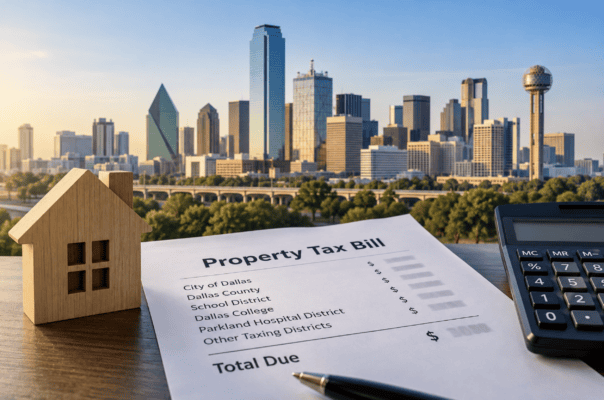
Dallas homeowners may have seen recent headlines about the city’s property tax rate. The Dallas City Council voted 8-6 to cap the city’s property tax rate at 69.78 cents per $100 of taxable value for the upcoming budget year. If that rate is ultimately adopted, it would extend Dallas’ streak of annual property tax rate reductions to 11 years.
But does a lower city tax rate mean Dallas homeowners will actually receive a lower property tax bill?
Not necessarily.
Your total property tax bill depends on more than the City of Dallas tax rate. Changes in your home’s taxable value, along with the rates charged by other local taxing entities, can still cause the amount you owe to increase.
What Did the Dallas City Council Approve?
The City Council voted to set 69.78 cents per $100 of taxable value as the maximum city property tax rate as officials continue working through the fiscal year 2026-27 budget.
The proposed rate is slightly below the current 69.88-cent rate. If adopted, it would continue the city’s long-running trend of reducing its property tax rate.
The city is also working to close a roughly $51 million budget gap as part of a proposed $5.66 billion budget. The proposal includes cutting nearly 300 positions as Dallas balances available revenue with spending priorities, including police and fire services.
The final budget is scheduled for adoption in September.
Why Your Property Tax Bill Could Still Increase
A lower tax rate does not automatically result in a lower property tax bill.
For an individual taxing unit, the basic calculation is:
Taxable Value ÷ 100 × Tax Rate = Property Tax
That means an increase in your property’s taxable value can offset a reduction in the tax rate.
There is another important factor: the City of Dallas is only one taxing entity that may appear on a homeowner’s property tax bill.
Depending on where you live, your overall bill may include taxes from entities such as:
- The City of Dallas
- Dallas County
- Your local school district
- Dallas College
- Parkland Hospital District
- Other applicable local taxing districts
Each taxing entity establishes its own tax rate. As a result, even if the City of Dallas lowers its rate, increases in taxable value or rates from other taxing entities can push your total bill higher.
Dallas County Is Moving in the Opposite Direction
While the City of Dallas is considering another small rate reduction, Dallas County adopted a higher rate for tax year 2026.
Dallas County adopted a tax rate of $0.248650 per $100 of taxable value, compared with $0.215500 per $100 for tax year 2025.
Because the adopted rate exceeds the county’s voter-approval tax rate, an election is scheduled for Nov. 3, 2026, for voters to approve or reject the higher rate.
This is a good example of why homeowners should look at their entire property tax bill, rather than focusing on the rate announced by any single taxing entity.
What Can Dallas Homeowners Do About Rising Property Taxes?
Even when local governments reduce tax rates, individual homeowners can still face significant property tax obligations.
Homeowners should review their tax records carefully and make sure they understand:
Their taxable value. Review the taxable value being used to calculate your taxes and make sure applicable exemptions are reflected.
Available exemptions. Homestead, over-65, disability and other exemptions may reduce taxable value for eligible property owners.
Important protest deadlines. If you disagree with your property’s appraised value, there is a limited period each year to file a protest with your appraisal district.
Payment options. If you cannot pay your property taxes in full, contact your tax office to determine whether an installment or other payment option may be available.
It is important to address delinquent property taxes before the balance continues to grow. Under Texas law, regular penalty charges can reach 12%, while interest continues to accrue at 1% per month. In certain circumstances, an additional collection penalty of up to 20% may also apply.
Need Help Managing Your Dallas Property Tax Bill?
A reduction in the City of Dallas tax rate does not necessarily mean your total property tax bill will go down.
For homeowners dealing with a growing tax burden, Home Tax Solutions offers property tax financing designed to make payments more manageable. Home Tax Solutions can pay the taxing authority directly, giving eligible homeowners the ability to repay the balance over time through a structured payment plan.
Have questions about current or delinquent property taxes? Contact Home Tax Solutions to learn more about your available options.